




Meet the Eagles: An Interview with Dremere Woods, Supplier Quality Engineer at Honda
About the Manufacturing Eagles Awards Winner
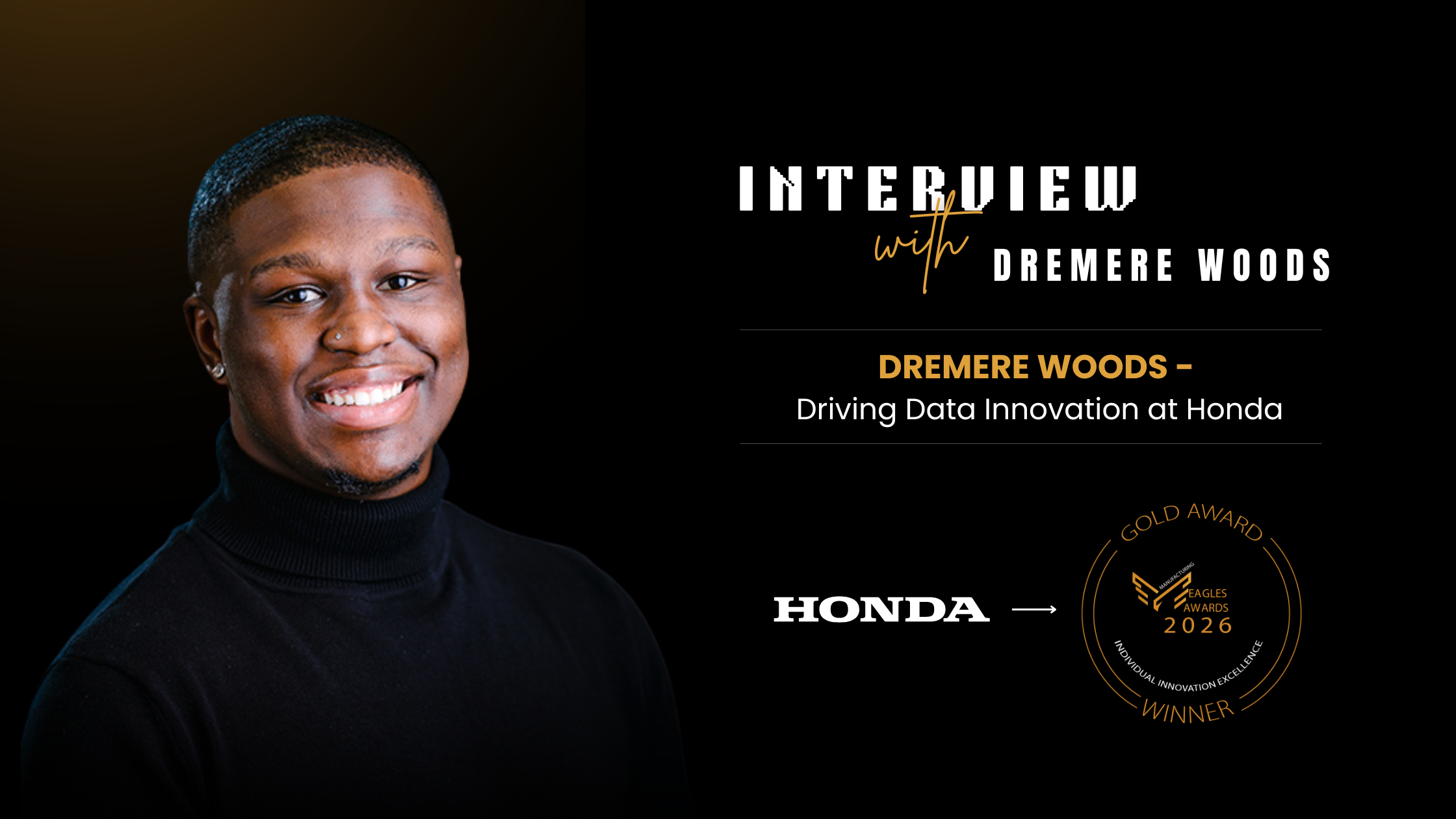
In this article we feature Dremere Woods, the Gold winner for Individual Innovation Excellence at the Manufacturing Eagles Awards 2026. His journey into advanced engineering reflects true resilience, evolving from foundational service roles in Alabama into a strategic leader managing high-stakes quality and risk for a global automotive giant.
As a Supplier Quality Engineer at Honda, an MBA candidate, and an intellectual property patent holder, Dremere has redefined operational performance by treating data not just as a tracking metric, but as a direct catalyst for action. His methodology is built on a unique interdisciplinary approach that bridges strict systems engineering with sharp business strategy. By focusing heavily on cross-functional problem solving and new model readiness, he ensures that complex manufacturing challenges find practical, sustainable improvements long before components ever hit the production line. Through this blend of technical discipline and creative foresight, Dremere proves that meaningful impact and leadership can be driven at any stage of a career.
“Growth, resilience, and continuous improvement are achievements worth recognizing. Do not wait until you feel accomplished enough to share your story.”
Interview with Dremere Woods, Supplier Quality Engineer at Honda
Congratulations on winning Gold in the Individual Innovation Excellence category at the Manufacturing Eagles Awards 2026. What does this recognition mean to you and your journey within the engineering and manufacturing sector?
Winning the Gold Award for Individual Innovation Excellence is incredibly meaningful because it represents a journey that began long before my engineering career. I grew up in Alabama and worked a variety of jobs while pursuing my education, including service and educational roles, before transitioning into engineering. Earning a degree in Industrial and Systems Engineering from Auburn University, pursuing my MBA at the University of Tennessee, and building a career within manufacturing required perseverance, discipline, and continuous learning. This award validates the effort invested over many years and motivates me to continue contributing to the future of manufacturing.
For those who may not be deeply embedded in advanced automotive production, could you briefly explain your core responsibilities as a Supplier Quality Engineer at Honda and how your role influences new model readiness?
As a Supplier Quality Engineer, I work closely with suppliers and internal teams to ensure components meet quality requirements before they reach production. My responsibilities include risk assessment, problem solving, quality planning, supplier development, and supporting new model activities. Quality issues identified early can prevent significant challenges later in production, so my role focuses on helping establish robust processes that support successful vehicle launches and long term customer satisfaction.
Your career journey reflects incredible resilience, moving from foundational service roles into advanced engineering, strategy, and corporate quality. What was the biggest personal or professional obstacle you had to overcome during this transition into Fortune 500 manufacturing environments?
One of my biggest challenges was navigating unfamiliar environments while continuously raising my own expectations. As a first generation engineering professional in my family, there was no roadmap for entering Fortune 500 organizations. I had to learn how to communicate effectively with leaders, build professional confidence, and adapt to highly technical environments while continuing my education. Each internship, role, and academic experience required me to step outside my comfort zone and trust my ability to grow.
Was there a specific manufacturing challenge or cross-functional problem-solving milestone where you realized your ability to translate complex data into practical, sustainable improvements was creating a measurable operational impact?
My Industrial and Systems Engineering background taught me that data only creates value when it leads to action. Throughout my career, I have been involved in projects where large amounts of technical information had to be translated into clear decisions for cross functional teams. Those experiences reinforced that successful engineering is not simply analysing data. It is helping people understand what the data means and turning insights into practical solutions that improve quality, efficiency, and long term performance.
The Industry Eagles Awards celebrate a unique balance of skills. The judges specifically highlighted your rare combination of sharp technical expertise, deep analytical thinking, and strong business awareness. Is this interdisciplinary approach something you attribute to your concurrent MBA studies at the University of Tennessee Knoxville, or is it driven by your background in Industrial and Systems Engineering?
It is the result of both. Industrial and Systems Engineering provided a strong foundation in systems thinking, process improvement, statistics, and operational excellence. My MBA studies have expanded my understanding of strategy, leadership, finance, and organisational decision making. Together, these experiences allow me to approach challenges from multiple perspectives and connect technical solutions with broader business objectives.
Innovation is central to your recognition, and you already hold a patent for an invention. What makes the synergy between engineering discipline and creative problem-solving so successful when trying to reduce operational risk and improve efficiency across complex supply chains?
Innovation happens when creativity is supported by structure. Engineering provides the discipline to evaluate ideas objectively, while creativity allows us to imagine possibilities that do not yet exist. My experience pursuing a patent reinforced that some of the best solutions emerge when curiosity, technical knowledge, and persistence are combined. Effective innovation is not about complexity. It is about finding practical ways to solve meaningful problems.
How has receiving major industry validation through the Industry Eagles Awards influenced the way you view your early-career contributions and your future goals within the manufacturing sector?
This recognition has reminded me that meaningful contributions can be made at any stage of a career. Early career professionals often underestimate the value they bring to organisations. This award has reinforced my confidence and encouraged me to continue investing in leadership development, advanced education, and technical excellence. It also motivates me to continue serving as a positive example for future engineers and young professionals.
This award places you among some of the sector’s most outstanding professionals. The judges noted that your work reflects a maturity and initiative that will influence the future of manufacturing; what specific elements of your submission or methodology do you believe helped your entry stand out?
I believe the combination of professional accomplishments, continuous learning, innovation, and leadership development helped differentiate my submission. My background includes engineering, graduate education, intellectual property development, professional certifications, community involvement, and recognition from multiple organizations. Rather than focusing on a single achievement, I wanted my submission to demonstrate a commitment to lifelong growth and meaningful impact.
Looking ahead, what are your next steps, and how will you use your skills, experiences, and values to drive sustainable innovation and lasting strategic impact in quality and supply chain management?
My goal is to continue developing at the intersection of engineering, business, quality, and operational excellence. I want to help organizations solve complex challenges, strengthen quality systems, and improve long term performance. I also hope to continue mentoring students and early career professionals while promoting opportunities within engineering and manufacturing. Ultimately, I want my career to create value not only through technical results but also through leadership and service.
Having experienced the Industry Eagles Awards firsthand, what advice would you give to ambitious young engineers and professionals who are considering putting their work forward or entering the Industry Eagles Awards 2027?
Do not wait until you feel accomplished enough to share your story. Growth, resilience, and continuous improvement are achievements worth recognizing. Invest in your education, seek opportunities that challenge you, build meaningful relationships, and stay committed to learning. Most importantly, believe that your experiences have value. The opportunities that have shaped my career often started with simply applying, showing up, and being willing to learn.
About the Industry Eagles Awards
The Industry Eagles Awards celebrate organizations and individuals who demonstrate exceptional vision, strategic execution, and sustainable excellence across diverse professional sectors.
The Industry Eagles Awards serve as the flagship programme of the Eagles Awards family, which includes Healthcare Eagles Awards, Financial Services Eagles Awards, Real Estate & Property Eagles Awards, IT Eagles Awards, Energy Eagles Awards, Retail Eagles Awards, Manufacturing Eagles Awards, Transport and Logistics Eagles Awards, Hospitality Eagles Awards, Education Eagles Awards, Legal Services Eagles Awards, and Construction Eagles Awards.
Each programme focuses on a distinct area of organisational performance, while maintaining a consistent standard of evaluation through an independent, blind judging process.


