



About the Eagles Awards Winner
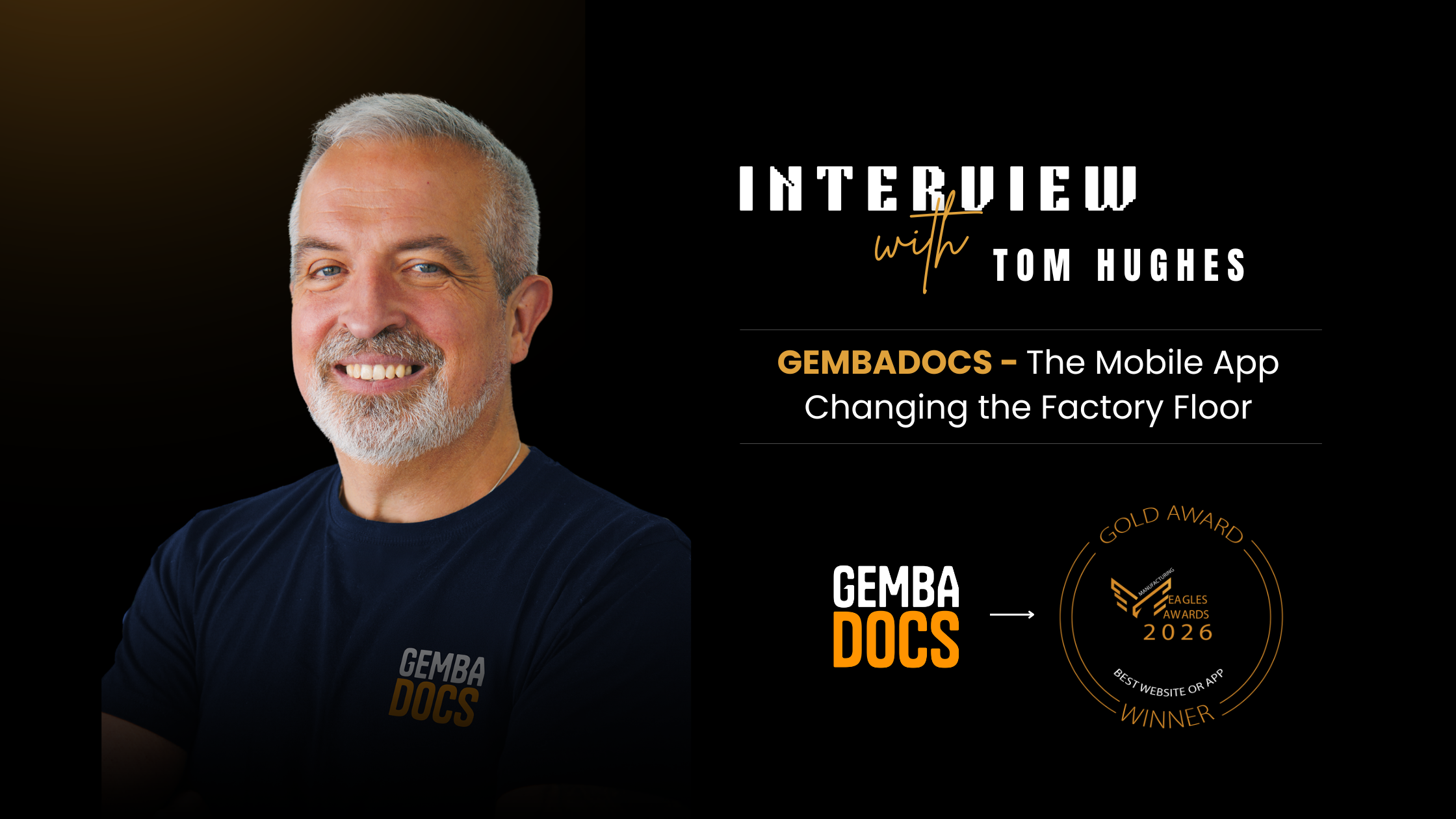
In this article, we feature Tom Hughes, CEO of GembaDocs, the Gold winner for Best Website or App at the Manufacturing Eagles Awards 2026. His journey with GembaDocs reflects a deep-seated commitment to practical, shop-floor innovation, evolving a targeted solution for a real manufacturing challenge into a globally adopted digital platform. By replacing outdated paper-based systems and clunky desktop software with an intuitive mobile experience, Tom has redefined operational performance across the manufacturing sector.
As the leader of a lean, highly focused team, Tom has pioneered a frontline-first approach to Standard Operating Procedures (SOPs). Under his direction, GembaDocs treats operational knowledge not as a top-down management metric, but as a living asset owned directly by the people on the shop floor. By integrating advanced features like an AI-assisted Video SOP Generator, voice-to-text functionality, and QR-enabled access, the platform empowers operators to document their own expertise in real time. Today, serving approximately 1,000 organizations across North America and Europe, Tom proves that impactful technology is born from simplicity, respect for people, and an unwavering focus on the frontline worker.
“Don’t wait until you feel big enough—we won Gold. The judges are looking for impact and authenticity, not headcount.”
An Interview with Tom Hughes, CEO of GembaDocs
Congratulations on winning Gold in the Best Website or App category at the Industry Eagles Awards 2026. What does this achievement mean to your team and organisation?
Honestly, it means a great deal – but perhaps not in the way you might expect.
We’re a small team, serving manufacturers that most software companies have never really bothered with. Small factories, lean teams, people on the shop floor who just need something that works. Winning Gold in a category competing against much larger businesses with far bigger budgets tells us that what we’re doing matters – and that it’s being recognised outside our own community.
But if I’m being straight about it, the thing that made this feel special was the reaction from our customers. A lot of our customers have been with us from nearly day one, and they don’t feel like customers – they feel like friends. When we told them about the award, they were genuinely delighted for us. That says something.
This platform wasn’t built in a boardroom. It was built with the people using it, on real production lines, through real conversations. So when an award like this comes in, it belongs to them as much as it does to us. They helped shape what GembaDocs is. This is recognition of their work too.
For those unfamiliar with the platform, could you briefly explain how GembaDocs works and how it redefines how manufacturing teams create and manage Standard Operating Procedures (SOPs)?
Most SOP software is built for someone sitting at a desk. A manager, an engineer, an office-based trainer. The person on the shop floor – the one actually doing the job – has traditionally had no real role in creating the documentation. They follow it, if they follow it at all.
GembaDocs flips that completely. We’re the only SOP platform built frontline worker first. The person at the machine, on the line, doing the job every day – they’re the ones creating the procedures.
What that changes is significant; when someone documents their own process, they own it. They understand it. They’re far more likely to follow it, improve it, and share it with the person starting next week. That’s the respect for people that lean is built on – and it’s very hard to achieve when documentation is done top-down.
In practical terms, you pick up your phone, record yourself doing the job, speak the steps as you go, and GembaDocs builds the SOP for you. No Word documents with formatting battles, and crucially, no waiting for someone in an office to write it up.
The result is that manufacturers can roll out standardised processes across their entire operation with minimal additional resource and no IT involvement. We’ve had customers go from fewer than ten SOPs to over 500 in their first year.
What was the biggest obstacle your team had to overcome when designing an intuitive mobile experience tailored specifically for frontline operators on a busy shop floor?
The honest answer is that our customers kept asking for more – and our biggest job was knowing when to say no.
Every manufacturer we work with has their own way of doing things. Different industries, different processes, different team sizes, different levels of digital confidence. When you’re listening closely to your customers, as we do, the natural pull is to accommodate every request… add this field, change that flow, build this variation.
But GembaDocs works because it’s simple. That’s not a happy accident, it’s a deliberate decision we have to protect every single day.
The core challenge was managing a huge diversity of customer requirements without letting that complexity bleed into the product. If we’d said yes to everything, we’d have ended up with another bloated platform that takes months to implement and needs an IT team to run. That’s exactly what we were trying to replace.
So the discipline was in filtering the ideas. Does this make it easier for the person on the shop floor, or does it make it easier for the person who commissioned the software? Those are very different questions. We always come back to the operator. If a feature doesn’t serve them, if it adds a step, creates confusion, or assumes desk access, it doesn’t go in.
That tension between richness and simplicity is still the hardest thing we manage. But getting it right is what makes the platform work for a 20-person factory in Belfast and a 300-person operation in Ontario.
Every successful development process has a defining moment. Was there a particular milestone that made you realise you were building a revolutionary tool?
There was one moment that I come back to a lot.
When we got the first working prototype of the mobile app into my hands, actually held it, used it, felt how it worked, I remember thinking very clearly: everyone is going to want this.
Not just the manufacturers we’d been talking to – everyone who has ever had to document a process and dreaded it. Everyone who’s watched tribal knowledge walk out the door with a retiring colleague and had no way to stop it. Everyone who’s handed a new starter a folder full of outdated paperwork and hoped for the best.
That moment of holding it and seeing it work the way we’d imagined, that was it. That was the light bulb.
It wasn’t a revenue milestone or a customer number that made it real. It was the simplicity of the thing in your hand. You could see immediately that this wasn’t just a better way to write SOPs. It was a way to give the person doing the job a genuine voice in how that job gets documented and improved.
The Industry Eagles Awards recognise innovation, excellence, and measurable results. With adoption now reaching approximately 1,000 organisations globally, which specific feature or metric from this journey are you most proud of, and why?
The numbers matter, the growth, the time saved, the volume of SOPs created. But the thing I’m most proud of is more specific than any metric.
It’s voice-to-text combined with AI polish. And the reason is what it unlocks.
Manufacturing is not a literacy-homogeneous environment. On any shop floor you’ll find people with decades of process knowledge who would never sit down and write a procedure – not because they don’t know the job, but because writing isn’t how they work.
You’ll have workers for whom English is a second language (if a language they speak at all). People who built all their expertise with their hands.
Traditional SOP tools excluded those people entirely. The knowledge stayed in their heads, and when they left, it left with them.
Voice-to-text changes that. If you know the process, you can document it. You speak it, the platform captures it, AI polish turns it into clear professional language. The person doing the job becomes the author of the standard. And they can do it in a range of languages.
User adoption and cultural buy-in play a huge role in manufacturing technology. What lessons have you learned from working closely with shop-floor professionals to ensure the app successfully captures their operational knowledge?
That last point leads directly into something we learned the hard way; and that one of our customers demonstrated better than we ever could have ourselves.
We work with a factory that employs ex-offenders as a deliberate preference (it’s where our Voice-to-Text feature was spawned from). Part of their values, part of how they operate. They came to us because they needed an easier way to document their processes – and what struck me about them was how seriously they took lean, and specifically the lean principle of respect for people.
The traditional way SOPs get created is top-down. Management and engineers document the process, hand it down to the shop floor, and expect it to be followed. The people actually doing the work have minimal involvement. And what you get, more often than not, is resentment. Standards that sit in a folder with procedures nobody uses.
What we’ve learned, and what that customer embodies, is that when documentation is built bottom-up. When you engage your people, involve them in their own processes, and give them the tools to document what they do, the ownership is completely different. People follow standards they helped create, they improve them and they train each other from them.
That’s a cultural outcome. But the product has to make it possible – and that’s exactly what we built GembaDocs to do.
How has receiving industry recognition through the Industry Eagles Awards influenced the way your development and leadership teams view their achievements and future potential?
This is our first publicly recognised award, and that matters more than it might sound.
We’re a young company and we don’t have the marketing budgets or the brand recognition of the businesses we were competing against. When you’re operating at that scale, it’s easy to measure yourself only against where you were last month – revenue, customers, SOPs created. We’re heads down, building, serving, growing.
Winning Gold, competing against established names and coming out on top, that lifts your head up. It tells you that what you’re doing isn’t just good relative to your own progress. It’s good by any standard.
For the team, that’s significant. It’s one thing for us to believe in what we’re building. It’s another for an independent panel of judges to look at the field and point at us.
It affirms that we can compete with much larger players and much larger budgets, and win. That’s the kind of confidence that changes how you think about what’s possible next.
Digital transformation on the frontline is becoming increasingly critical across the manufacturing sector. How do you see mobile-first platforms like GembaDocs shaping the future of operational standardisation?
The direction is clear. The people doing the work need to be at the centre of how that work gets documented, shared, and improved. Mobile-first isn’t a trend, as it’s the only architecture that makes that possible at scale.
For us, the future has two priorities:
The first is maintaining simplicity. As platforms grow, the temptation is always to add. We’ll resist that where it compromises ease of use. The moment GembaDocs becomes something you need training to operate, we’ve lost the plot. The operator on the floor has to be able to pick it up and use it and that will always be the test.
The second is connectivity. Standard work doesn’t exist in isolation, it connects to quality systems, ERP platforms, skills records, production data. The future we’re building toward is one where GembaDocs sits naturally within a manufacturer’s wider digital environment — feeding standardisation information to the places it’s needed, when it’s needed, without friction.
This award places your platform among some of the industry’s most outstanding digital solutions. The judges highlighted your “frontline-first approach” to an underserved segment; what do you believe helped your submission stand out?
Two things, honestly. The metrics and the people behind them.
We were able to show the judges exactly how much time our customers save creating SOPs – not as an estimate, not as a projection, but as a measured outcome from real organisations. Customers averaging 81% reductions in SOP creation time. Procedures that used to take hours being completed in minutes. By the person doing the job, not someone employed to write it up for them.
When a dedicated technical author documents a process, it costs time and salary. When the operator does it themselves in fifteen minutes on their phone, the economics of standardisation change completely. We put that case clearly.
But the numbers only carry weight when real people stand behind them. The testimonials we included were from customers who have genuinely built their operations around GembaDocs — people who could speak to what it changed and why. That authenticity is hard to manufacture and judges can tell the difference.
I think what stood out was that we weren’t making a case for what the platform could do. We were showing what it already had done, in the words of the people it had done it for.
Looking ahead, what are the next steps for GembaDocs across North America and Europe, and how will this award-winning platform help drive future technological innovation and market growth?
Growth across both markets is firmly in our sights – and this award helps. It opens doors and starts conversations that might otherwise take much longer to have.
But if you’re asking about the product itself, the answer is judicious use of AI. And I want to be specific about what that means, because it’s easy to say and harder to do well.
AI in GembaDocs exists to remove friction, not to replace knowledge. There’s a version of AI-assisted documentation where the software writes the SOP for you, pulls from a database, generates a procedure, fills the page. It looks complete and it might even look professional.
But it’s digital wallpaper.
If the person doing the job hasn’t derived that knowledge themselves, hasn’t worked through the process, made the decisions, captured what they actually do, then the standard isn’t real. It won’t reflect how the job is done, owned and it won’t be followed properly.
The AI we’re building into GembaDocs does something different. It tidies language, removes barriers to expression, helps someone who knows the process communicate it clearly. The knowledge still comes from the person at the machine – and that’s non-negotiable for us.
So the roadmap is more capability, sharper integrations, deeper reach into North America and Europe, but always with that discipline intact. We’re not here to automate away the human knowledge that makes manufacturing work, we’re here to make capturing it as easy as possible.
Having experienced the Industry Eagles Awards firsthand, what advice would you give to technology providers considering entering or attending the Industry Eagles Awards 2027?
Enter. Genuinely, just enter.
What I’d say first is that this is a fair process. It’s judged blind, which means your submission stands on its own merits. You’re not competing on brand recognition or on who knows who. That’s rare, and it matters – particularly if you’re a smaller company that might otherwise assume these things aren’t for you.
We assumed that for too long.
The discipline of putting a submission together is valuable in itself. It forces you to look clearly at what you’ve actually built, what it’s achieved, and what makes it different. A lot of technology companies are so focused on the next release that they never stop to articulate the impact of what they’ve already shipped. The entry process makes you do that.
And if your product genuinely serves the people it’s built for, if you have real results and real customers who’ll speak to that, then you have a stronger case than you probably think.
Don’t wait until you feel big enough – we won Gold. The judges are looking for impact and authenticity, not headcount.
About the Industry Eagles Awards
The Industry Eagles Awards celebrate organizations and individuals who demonstrate exceptional vision, strategic execution, and sustainable excellence across diverse professional sectors.
The Industry Eagles Awards serve as the flagship programme of the Eagles Awards family, which includes Healthcare Eagles Awards, Financial Services Eagles Awards, Real Estate & Property Eagles Awards, IT Eagles Awards, Energy Eagles Awards, Retail Eagles Awards, Manufacturing Eagles Awards, Transport and Logistics Eagles Awards, Hospitality Eagles Awards, Education Eagles Awards, Legal Services Eagles Awards, and Construction Eagles Awards.
Each programme focuses on a distinct area of organisational performance, while maintaining a consistent standard of evaluation through an independent, blind judging process.
Meet the Eagles: An Interview with Tom Hughes, CEO of GembaDocs
About the Eagles Awards Winner In this article, we feature Tom Hughes, CEO of GembaDocs, the Gold winner for Best Website or App at the Manufacturing Eagles Awards 2026. His journey with GembaDocs reflects a deep-seated commitment to practical, shop-floor innovation, evolving a targeted solution for a real manufacturing challenge into a globally adopted digital platform. By replacing outdated paper-based systems and clunky desktop software with an intuitive mobile experience, Tom has redefined operational performance across the manufacturing sector. As the leader

Meet the Eagles: An Interview with Dremere Woods, Supplier Quality Engineer at Honda
About the Manufacturing Eagles Awards Winner In this article we feature Dremere Woods, the Gold winner for Individual Innovation Excellence at the Manufacturing Eagles Awards 2026. His journey into advanced engineering reflects true resilience, evolving from foundational service roles in Alabama into a strategic leader managing high-stakes quality and risk for a global automotive giant. As a Supplier Quality Engineer at Honda, an MBA candidate, and an intellectual property patent holder, Dremere has redefined operational performance by treating data not just as
Top 5 Mistakes to Avoid When Submitting Your Award Entry
Entering an award can open doors for your organisation, but only if your submission does your work justice. Many strong projects fall short because of small, avoidable mistakes. Here are the most common pitfalls judges see, and how to avoid them. 1. Telling the story without structure Some entries jump straight into details without explaining what the project was about. Judges don’t know your organisation, your team, or your timeline — you have to guide them.Keep it simple: what you did, why

What You Should Expect at the Industry Eagles Awards Ceremony
An awards ceremony is never just about trophies or applause. It’s about the atmosphere in the room, the people gathered together, and the shared sense of achievement that comes with recognising meaningful work. The Industry Eagles Awards ceremony is more than a formal event; it is an evening dedicated to celebrating organisations and individuals whose work is making a genuine impact across their industries. A Celebration of Achievement Behind every nomination are hours of work, creativity, and persistence. The ceremony brings these achievements into